High-Performance Vision Guidance
VSTeach
Primitive Description and Usage
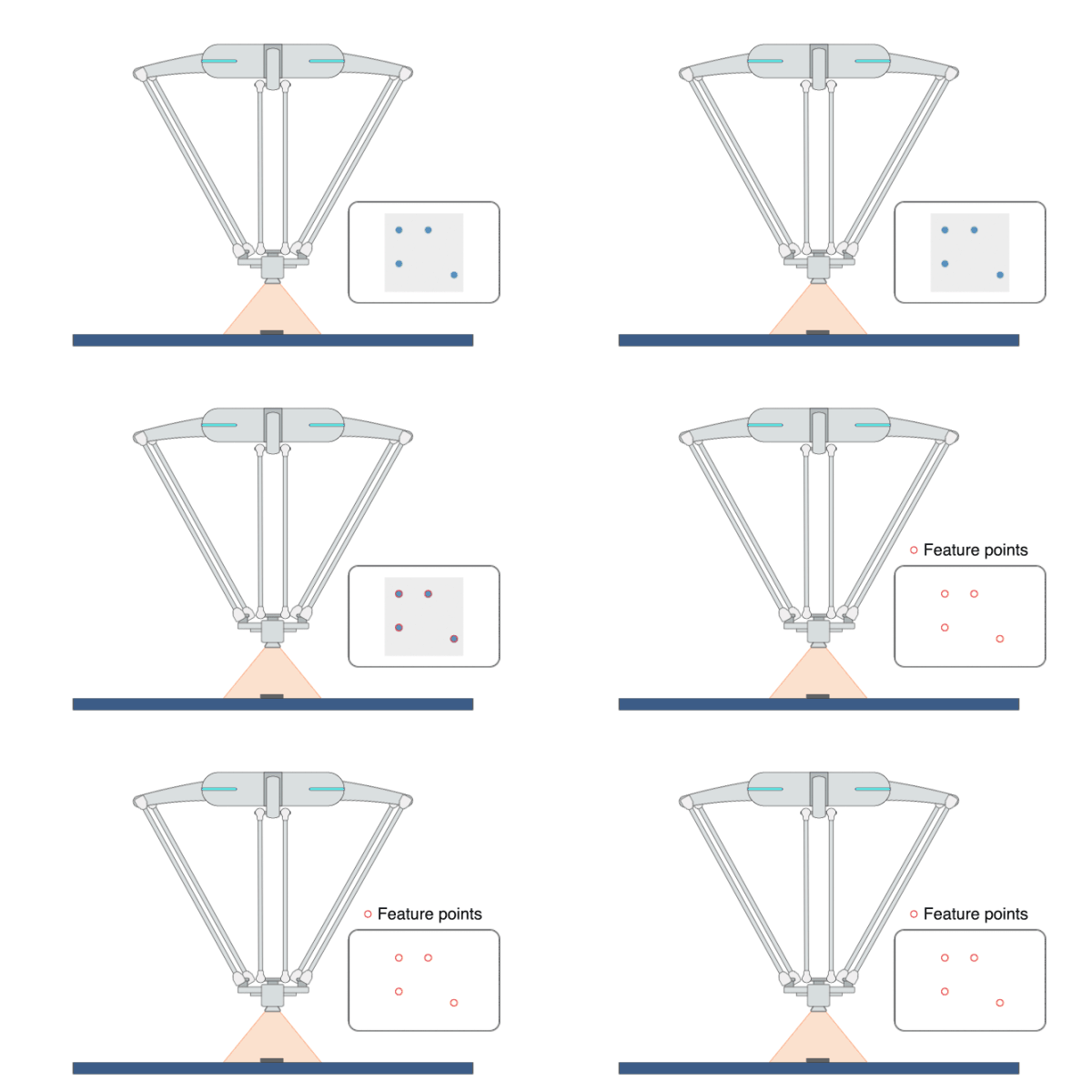
Description: This primitive collects samples of image feature data or object poses from the visual system multiple times and outputs their average values.
Example Usage: Use this primitive to record the features of the target image or the poses of the target object after moving the robot to the target position. You can record the values of the output parameters of this primitive into variables and then use them in the primitives [HPImageBasedVS] or [HPPoseBasedVS].
Primitive Input Parameters
Input Parameter |
Description |
Type |
Unit |
Default Value & Range |
|---|---|---|---|---|
objName* |
Object name used by visual servoing |
OBJNAME |
none |
|
objIndex |
Object index used by visual servoing |
INT |
none |
0 ∈ [0 … 1] |
collectTimes |
Number of times of collecting image feature samples |
INT |
none |
30 ∈ [10 … 200] |
*Parameters marked with an asterisk must be assigned a value prior to executing the primitive.
Primitive State Parameters
State Parameter |
Description |
Type |
Unit |
|---|---|---|---|
terminated |
Flag to indicate whether the primitive is terminated. It is set to TRUE if the primitive is terminated. |
BOOL |
none |
timePeriod |
The time spent on running the current primitive. |
DOUBLE |
s |
teachFinished |
Flag to indicate whether the teaching data collection is complete |
BOOL |
none |
Primitive Output Parameters
Output Parameter |
Description |
Type |
Unit |
|---|---|---|---|
tcpPoseOut |
The TCP pose when the primitive is terminated. It is represented in the world coordinate system. |
COORD |
m-deg |
taughtFeaturePts2D |
Positions of multiple taught feature points in the 2D camera coordinate system. Its value can be used as the input parameter [targetFeaturePts] for the primitive [HPImageBasedVS]. |
ARRAY_VEC_2d |
none |
taughtAlignPts2D |
Positions of the feature points of the aligned object in the 2D camera coordinate system during teaching. Its value can be used as the input parameter [alignObjPts] for the primitive [HPImageBasedVS]. |
ARRAY_VEC_2d |
none |
taughtFeaturePtsNoise |
Noise of the taught 2D feature points. Its value can be used as the input parameter [visualDetectNoise] for the primitive [HPImageBasedVS]. |
ARRAY_VEC_2d |
none |
taughtFeaturePts3D |
Positions of multiple taught feature points in the 3D camera coordinate system. Its value can be used as the input parameter [targetFeaturePts] for the primitive [HPPoseBasedVS]. |
ARRAY_VEC_3d |
m |
taughtAlignPts3D |
Positions of the feature points of the aligned object in the 3D camera coordinate system during teaching. Its value can be used as the input parameter [alignObjPts] for the primitive [HPPoseBasedVS]. |
ARRAY_VEC_3d |
m |
taughtObjPose |
Pose of the target object taught in the 3D camera coordinate system. Its value can be used as the input parameter [targetObjPose] for the primitive [HPPoseBasedVS]. |
POSE |
mm-deg |
taughtAlignPose |
Pose of the aligned object in the 3D camera coordinate system during teaching. Its value can be used as the input parameter [alignObjPose] for the primitive [HPPoseBasedVS]. |
POSE |
mm-deg |
Default Transition Condition
State Parameter |
Condition |
Value |
|---|---|---|
teachFinished |
= |
1 |

HPImageBasedVS
Primitive Description and Usage
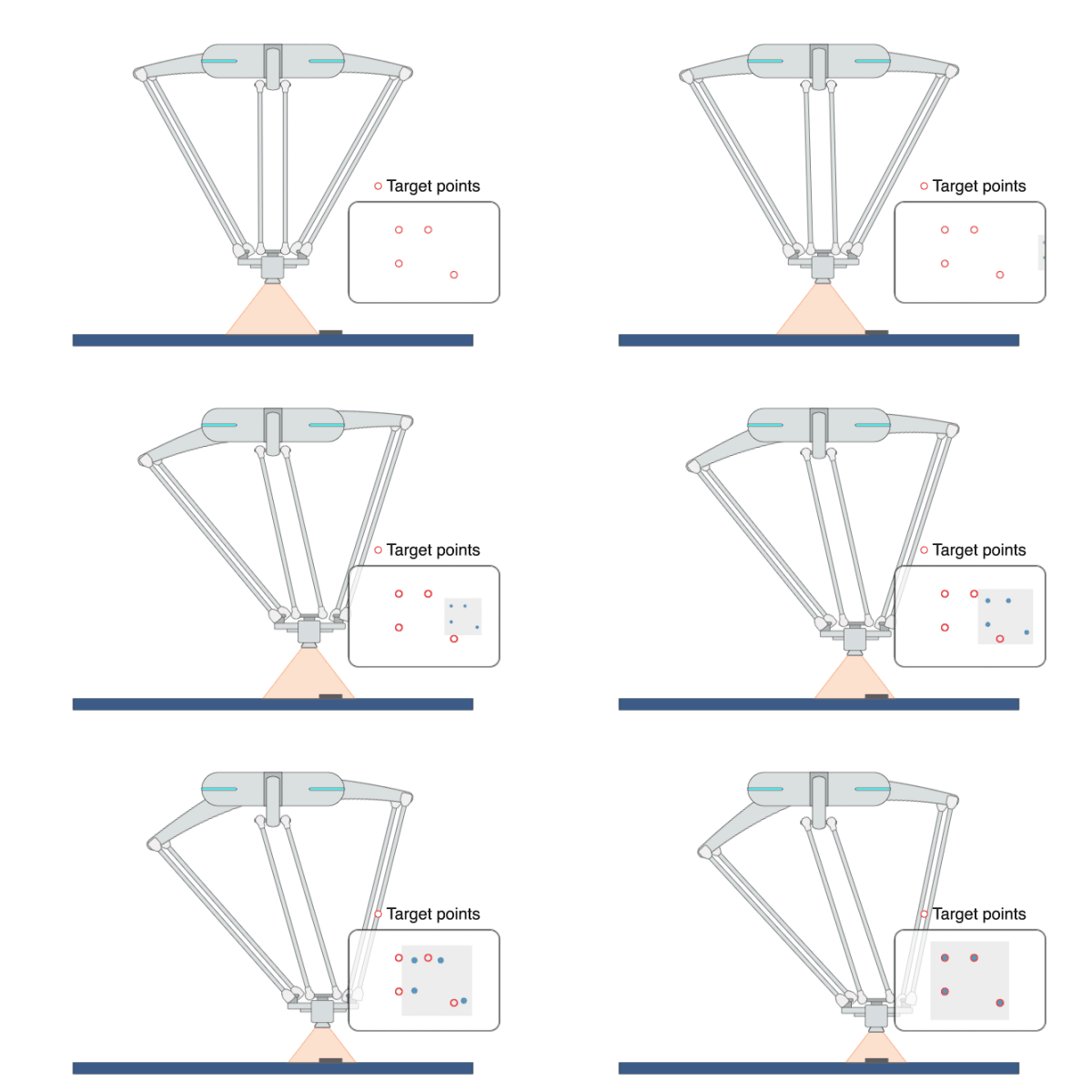
Description: This primitive uses Image-Based Visual Servoing (IBVS), leveraging real-time visual feedback to continuously control the robot to track objects with random and unpredictable positions, achieving high-precision, high-responsiveness, and quasi-static tracking. During this process, the robot moves along the visual servoing axes to align the feature points on the target object with the target feature points.
Example Usage: Use this primitive to control the robot to locate an object whose position is uncertain or changing on the plane. This primitive can also be used to align two objects, such as aligning an FPC cable with a socket.
Primitive Input Parameters
Input Parameter |
Description |
Type |
Unit |
Default Value & Range |
|---|---|---|---|---|
objName* |
Object name used by visual servoing |
OBJNAME |
none |
|
objIndex |
Object index used by visual servoing |
INT |
none |
0 ∈ [0 … 1] |
targetFeaturePts* |
Position of the target feature points in the 2D camera coordinate system. Each point is represented by two pixel values (X, Y). |
ARRAY_VEC_2d |
none |
|
targetDepth* |
Depth of target feature points in the camera coordinate system |
ARRAY_DOUBLE |
m |
[0.01 … 1.2] |
vsAxis |
Axes that are allowed to move in the camera coordinate system |
VEC_6i |
none |
1 1 1 0 0 0 ∈ [0 0 0 0 0 0 … 1 1 1 0 0 0] |
velScale |
Velocity scale of visual servoing. Caution: Setting this value too large may cause robot vibration. |
DOUBLE |
none |
10 ∈ [1.0 … 100.0] |
maxVel |
Maximum linear velocity of robot movement |
DOUBLE |
m/s |
0.05 ∈ [0.001 … 0.5] |
imageConvToler |
Tolerance for determining whether the image has converged. When the error between the captured image features and the target features is within the tolerance, it will be determined that convergence has occurred. |
DOUBLE |
none |
5.0 ∈ [1 … 50] |
targetConvTimes |
Number of consecutive times the target simultaneously meets the image convergence tolerances. When the number of consecutive convergences reaches this set value, the parameter [objAligned] will be set to TRUE; 0 indicates that [objAligned] will never be TRUE. |
INT |
none |
4 ∈ [0 … 20] |
timeoutTime |
Maximum time interval allowed for receiving data. A fault will be triggered if the robot fails to receive visual feedback data within this time interval. |
DOUBLE |
s |
3 ∈ [0.1 … 10] |
enableObjAlign |
Flag to enable the object alignment function. This function can be used to align the feature points of two objects. |
BOOL |
none |
0 ∈ [0 / 1] |
alignObjPts |
Position of feature points of aligned object in the 2D camera coordinate system. Each point is represented by two pixel values (X, Y). The aligned object is in the robot hand and is moved by the robot. |
ARRAY_VEC_2d |
none |
|
optVelScale |
Increase the velocity scale of visual servoing in the Z and Rz directions. It can help optimize the robot’s Cartesian motion trajectory. |
VEC_2d |
none |
0 0 ∈ [0 0 … 100 0] |
visualDetectNoise |
Noise of the visual detection result of each feature point |
ARRAY_VEC_2d |
none |
[0 0 … 20 20] |
*Parameters marked with an asterisk must be assigned a value prior to executing the primitive.
Primitive State Parameters
State Parameter |
Description |
Type |
Unit |
|---|---|---|---|
terminated |
Flag to indicate whether the primitive is terminated. It is set to TRUE if the primitive is terminated. |
BOOL |
none |
timePeriod |
The time spent on running the current primitive. |
DOUBLE |
s |
objAligned |
Flag to indicate whether visual servoing has successfully aligned the target object |
BOOL |
none |
Primitive Output Parameters
Output Parameter |
Description |
Type |
Unit |
|---|---|---|---|
tcpPoseOut |
The TCP pose when the primitive is terminated. It is represented in the world coordinate system. |
COORD |
m-deg |
Default Transition Condition
State Parameter |
Condition |
Value |
|---|---|---|
reachedTarget |
= |
1 |